
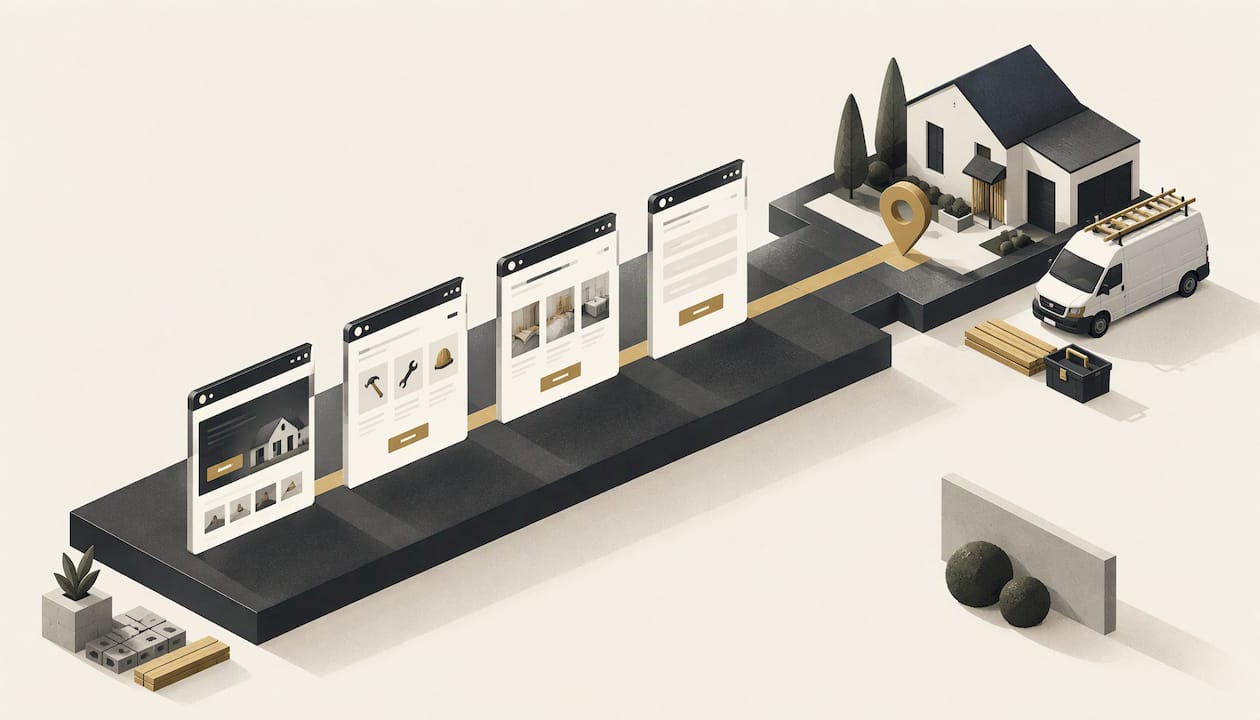
A good tradie website does one job: it gets a homeowner or builder from "I need someone" to a call or quote request in under a minute. That means a fast mobile site, your phone number in plain view, one page per type of job, real proof of your work, and someone keeping it secure and current. Everything below is about building exactly that, and what it takes to get it done without losing a week of work on the tools.
TL;DR
- Design for the phone first. Most urgent searches for a plumber, sparky or locksmith happen on a mobile, so the number and a call button must be on the first screen.
- Give each service its own page, with the suburbs you cover, your licence details and photos of finished jobs.
- Use only genuine reviews and photos. Misleading testimonials are against the law in Australia.
- Keep the site updated, backed up and secure. A neglected site loses trust and can be hacked.
- A custom, hand-built site starts at $199 with us, and we deliver in five business days.
Table of Contents
- What a tradie website actually has to do
- The pages every tradie site needs
- Mobile-first design and speed
- Local SEO and calls to action
- Build trust with proof, not claims
- Custom site, template or DIY builder?
- Keeping the site secure and current
- What a tradie website costs with us
- Getting your site built with Webline Studio
- A simple checklist before you launch
- FAQ
- Sources
What a tradie website actually has to do
Most tradies don't need a website that wins design awards. You need one that answers three questions quickly: what do you do, where do you work, and how fast can you turn up. TradeAds advises answering those in the first screen, loading in under three seconds on a phone, and showing proof such as reviews, a licence number and before-and-after photos.
Think about who is on the other end. A burst pipe at 7pm, a switchboard that keeps tripping, a deck quote for the weekend. These people are comparing two or three businesses on their phone, often while stressed or busy. The site that is clear, quick and credible gets the call. The one that makes them pinch, zoom and hunt for a number doesn't.
A website also works while you're on a roof. It answers the repeat questions (do you do emergency work, do you cover my suburb, are you licensed) so that the calls you do get are from people ready to book.
The pages every tradie site needs
You can cover the essentials with a small site. Here is what we'd put on it.
Home page
The first screen should state your trade, your area and your hook (same-day service, free quotes, 24/7 emergency, whatever is true for you). Put your phone number and a clear button for quotes right there. Below it, list your main services, a few reviews, and a short line on who you are.
One page per service
Don't squeeze "hot water, blocked drains, gas fitting and bathroom renovations" onto one page. TradeAds recommends a dedicated page for each job type, and the reasoning holds up: a person searching for blocked drains wants to land on a page about blocked drains, with the price guidance, process and photos that apply to that job.
Each service page should cover:
- What the job involves, in plain words
- The suburbs or region you cover
- How quickly you can usually attend
- How you quote (fixed price, site visit, hourly)
- Two or three photos of your own work
- A call button and a short enquiry form
Projects or gallery
Real photos of real jobs beat stock images every time. Show the before, the after and a line on what was done. Keep it to your best work rather than every job you've ever done.

About page
People let tradies into their homes. A short page with your name, your face, how long you've been working and the licences you hold does a lot of persuading. If you have a small team, show them.
Contact page
Phone, email, service area, hours and a short form. Keep the form to name, number, suburb and what you need. Every extra field costs you enquiries.

Mobile-first design and speed
Design the phone version first, then scale up. Tap targets need to be big enough for a thumb, text readable without zooming, and the call button should stay visible as someone scrolls. TradeAds suggests a phone number above the fold with a sticky call button on mobile, which is simple to build and matches how people actually browse in a hurry.
Speed is part of the same job. Oversized photos straight from your phone are the usual culprit. They should be resized and compressed before going on the site. Slow plugins and bloated page layouts are the other common cause, which is one reason we build sites from scratch rather than layering on heavy add-ons. If you want to go deeper, we've written about why mobile-friendly design matters.
Local SEO and calls to action
Customers searching for a tradie usually add a suburb or city. Your site needs to say clearly which areas you work in, on the pages that matter, so search engines and people can both tell.
The basics that make the difference:
- Your business name, phone number and service area written the same way everywhere, including your Google Business Profile and social pages
- A title and heading on each service page that names the job and the area, in natural language
- Suburb or region mentions on service pages, written for readers, not stuffed in a list
- Reviews and photos that tie back to your jobs
Our simple SEO tips for local businesses walk through the setup in more detail. SEO setup is included in our builds.
On calls to action, be specific and repeat them. "Call now" or "Get a free quote" should appear at the top, in the middle and at the bottom of key pages. One main action per page works best. If someone is on your emergency plumbing page, the call button matters more than the quote form.
Build trust with proof, not claims
Anyone can write "quality work, reliable service". What convinces people is evidence they can see.
- Licence numbers and insurance: show them in the footer or on the about page. Licensing rules differ by state and trade, so use the details your own licensing body issues.
- Reviews: feature a handful of genuine ones with first name and suburb, and link to your Google profile.
- Photos: your own work, with brief captions.
- Clear service information: what you do, what you don't, how you price, and how soon you can start.
One firm rule on reviews. NSW Fair Trading states that false or misleading testimonials and reviews are against the law, because they can push customers into decisions they otherwise wouldn't make. Only publish reviews from real customers, don't write your own, and don't edit what someone said. Other states and the ACCC have their own consumer rules, so if you're outside NSW, check your local fair trading office.
We've covered the wider picture in what makes a website feel trustworthy, and the red flags in five signs your website is costing you customers.
Custom site, template or DIY builder?
This is the choice most tradies face, so here's how we'd think about it.
| Factor | Hand-built custom site | Template or DIY builder |
|---|---|---|
| Upfront effort from you | Low: you brief, we build | High: you design, write and set up |
| Look and feel | Tailored to your brand and trade | Shared layouts, many sites look alike |
| Time on the tools | Minimal | Evenings and weekends |
| Speed and cleanliness | Built lean, only what you need | Often carries extra code and features |
| Ongoing upkeep | Handled by a care plan | Down to you |
A template can be fine if you enjoy tinkering and have the time. Most tradies we speak to don't, and a half-finished site with placeholder text does more harm than none. If your time is worth more on the job than at the laptop, a done-for-you site is usually the better trade. Our post on how much a small business website should cost breaks down what you're paying for.
Our perspective
We build every site from scratch, by hand, for local businesses, and tradies are exactly who that approach suits. A plumber in Parramatta and a landscaper on the Sunshine Coast have different customers, different areas and different ways of winning work. A one-size layout can't reflect that.
We also think the website should be the least stressful part of running your business. That's why we aim to deliver in five business days, why there are no lock-in contracts, and why we back our work with a satisfaction guarantee. If it isn't right, we want to fix it, not argue.
Our view on what matters most is simple: clear service pages, your phone number where thumbs can reach it, genuine photos and reviews, and a site that is kept updated and secure. Get those right and the design takes care of the rest. A hand-built site, kept in good order by a small team who know your name, is the best use of a modest budget.
Tyler
Keeping the site secure and current
A site is not a set-and-forget brochure. Software ages, and attackers scan for sites that haven't been updated.
The Australian Cyber Security Centre recommends that patches for online services be applied within two weeks, or within 48 hours where a vendor rates them critical or exploits are known. It also notes that once a vulnerability in an online service is public, malicious code can be expected within 48 hours, sometimes within 24.
Its Secure your website guidance lists the actions for site owners:
- Turn on multi-factor authentication for administrator accounts
- Use HTTPS
- Use strong passwords and sensible access controls
- Back up site data regularly and keep software, devices and plugins up to date
- Review the site for suspicious activity
That is a real list of chores for someone who already works ten-hour days. It's why we offer monthly care plans covering hosting, performance monitoring, content updates, error fixes and security updates. You can also read how often you should update your website for a practical rhythm.
Content matters too. Add new project photos, update your service area, swap out an old phone number or price. A site that still lists last year's details costs you the trust you've worked to earn.
What a tradie website costs with us
Our published prices are one-off fees for the build, then an optional monthly plan for ongoing care.
| Item | Price |
|---|---|
| Base Build | $199 one-off |
| Upgraded Build | $399 one-off |
| Premium Build | $449 one-off |
| Custom Logo | $300 one-off |
| Base Care | $9 per month |
| Upgraded Care | $24 per month |
| Premium Care | $29 per month |
See the pricing page for what each build and plan covers. There are no lock-in contracts, so you can adjust your care plan as the business changes.
Getting your site built with Webline Studio
We build custom websites for local businesses, and tradies are a natural fit. That includes hand-crafted layouts, copywriting, mobile-friendly design, SEO setup and a fast, secure launch. If you don't have a logo you're happy with, we can design one too. Sites go live in five business days, and our satisfaction guarantee backs the result.

If you're ready, start your website here, or see how we work first. For the bigger picture on why this matters, read why your local business needs a website in 2026.
A simple checklist before you launch
Run through this before your site goes live, and again whenever you update it:
- Phone number on the first screen, and tapping it starts a call
- Each main service has its own page
- Service areas named clearly
- Licence number visible
- At least a few genuine reviews and real project photos
- Quote form short and tested
- Pages load quickly on a phone over mobile data
- Admin logins protected with multi-factor authentication
- A plan for backups and updates
FAQ
Do tradies really need a website if they get work by word of mouth?
Yes. Even when a referral comes in, people tend to look you up before they call. A clear site with your services, area, licence details and photos confirms the recommendation. It also catches the customers who never heard of you but searched for your trade in their suburb.
How many pages should a tradie website have?
Start with a home page, one page per main service, a projects page, an about page and a contact page. That's enough for most trades. You can add pages later as you take on new types of work.
Can I use customer reviews on my site?
Yes, as long as they're genuine and not edited to mislead. NSW Fair Trading says false or misleading testimonials are against the law. Ask real customers for permission, keep their wording intact, and don't write reviews yourself.
How long does a custom site take to build?
With us, five business days. The speed depends on how quickly you can send your logo, photos and service details, so having those ready helps.
Do I need ongoing website care?
Your site needs updates, backups and security checks whether you do them yourself or not. Our care plans, from $9 per month, take that off your plate and include hosting, monitoring, content updates and fixes. There are no lock-in contracts.
Sources
- TradeAds: Website Conversion Optimisation for Tradies
- NSW Government: False or misleading representations
- Cyber.gov.au: Patching applications and operating systems
- Cyber.gov.au: Secure your website